Arts and Sciences Osu Visual and Performing Art Ge
Central Takeaways
-
Visualize the chances of earning an A in different GE classes and look upwardly any GE course.
-
Science GEs take the toughest curves, while visual and functioning arts GEs are the most generous.
-
In some "easy" GE classes, curves can vary quite a bit betwixt different lectures.
Well-chosen general instruction classes can be nifty GPA boosters.
The latest Bruinwalk data offers an unprecedented look at letter-grade distributions of every class taught at UCLA between fall 2012 and autumn 2015.
Information technology's likewise a corking guide for choosing easy GE courses.
There are many ways to measure the difficulty of a GE class aside from grades – difficulty of content, workload and frequency of assessments, among other qualities.
In this post, we'll apply the percentage of students who got an A+, A or A- in a given class equally our metric. While it does not depict complete grade distributions, the metric is the almost intuitive one for students who want to choose GE classes that can boost their GPAs.
A's heave grades. B's and C'south? Not and then much.
A bird's-eye view of all GEs
In the following scatterplot, the x-axis shows the median percentage of students who earned A'south across unlike sections of a class. The y-axis shows the number of times the course was taught between fall 2012 and fall 2015.
A "frequently taught" class is one that has been offered at least five times since autumn 2012. In an "easy" form, at to the lowest degree 60 percent of students earned A'southward. In a "hard" class, at most 30 pct of students earned A's. A "big" course had a median class size of at to the lowest degree 100 people, and a "small" class had a median class size of at virtually forty people.
Why science GEs have the toughest curves
When we examined boilerplate course class distributions for each GE requirement, we ended science GEs have the toughest curves.
On average, only 30 percent of students who took a physical sciences GE course earned A'southward. Life science GEs follow, with an average of 40 percent of students earning A'south.
Students were twice as likely to earn A's in a typical visual and operation arts class than in a life sciences class.
Check out the chart beneath.
Why might this be the case? Most N Campus classes have more favorable form distributions than South Campus ones, but there may be another explanation.
Many of the tougher science GEs are really core classes many South Campus students are required to accept – and many are known to be "weeder" classes.
| Subject | CatalogNo | Proper noun | PercentA |
|---|
Fewer courses that fulfill social science or humanities GE requirements are prerequisite courses for North Campus students. Have a look at the literary and cultural GE courses listed below. Information technology is less probable students enrolled in most of these GEs are competing to establish a strong GPA in curricula required by their major or in graduate schoolhouse.
| Subject | CatalogNo | Name | PercentA |
|---|
Some GEs have very inconsistent curves between lectures
Median statistics don't quite capture how some professors course differently between their lectures. An assay of complete course distributions revealed some professors graded very differently lecture to lecture.
Therefore, some well-known, easy GE courses may not be every bit like shooting fish in a barrel as rumored. For case, median values suggest 76 percentage of students who took German 102: "State of war, Politics, Art" earned A'southward. But in ii of the five lectures, less than half of the students earned A'due south.
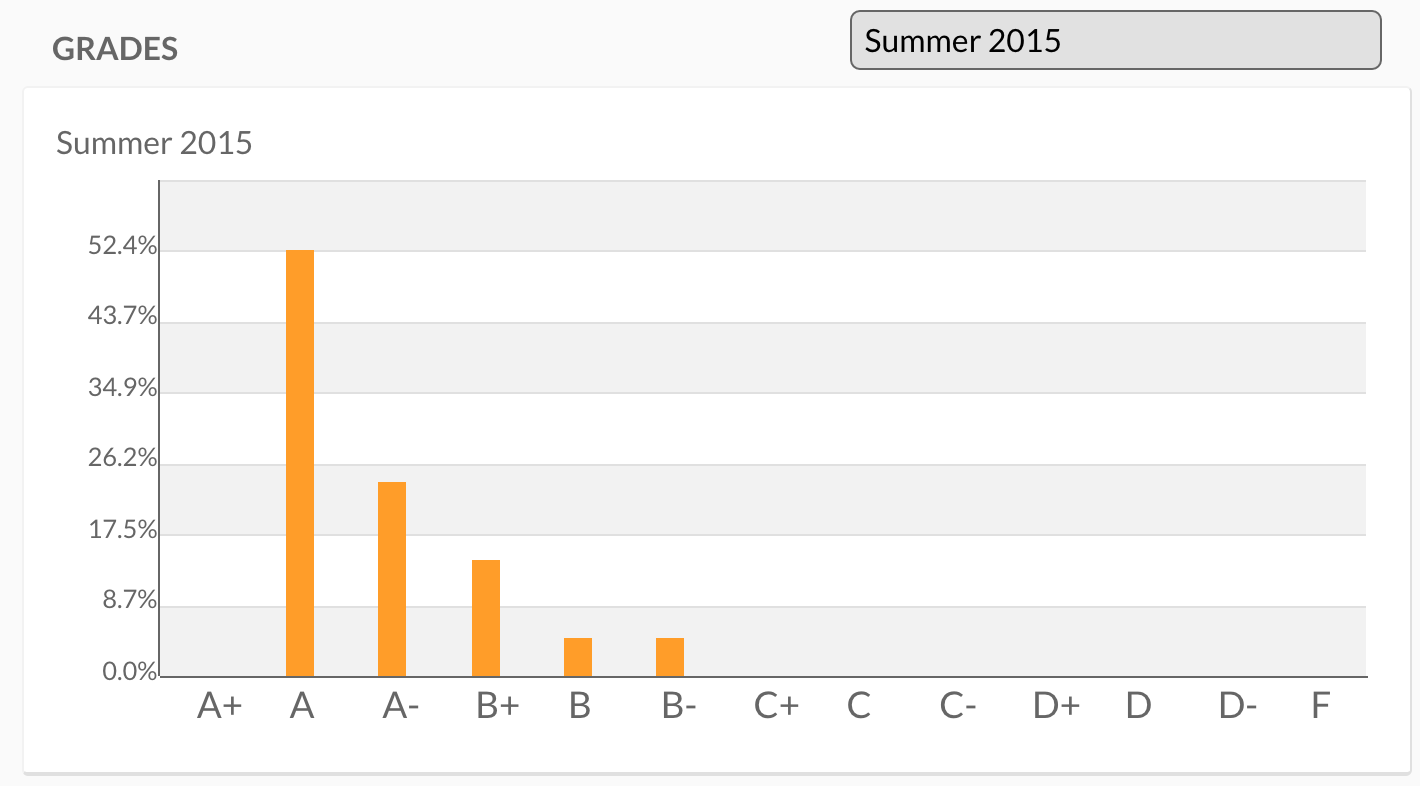
It's important to take a more involved approach when choosing classes that have inconsistent lecture-to-lecture curves. Researching professors and reading reviews can mitigate some of the uncertainty.
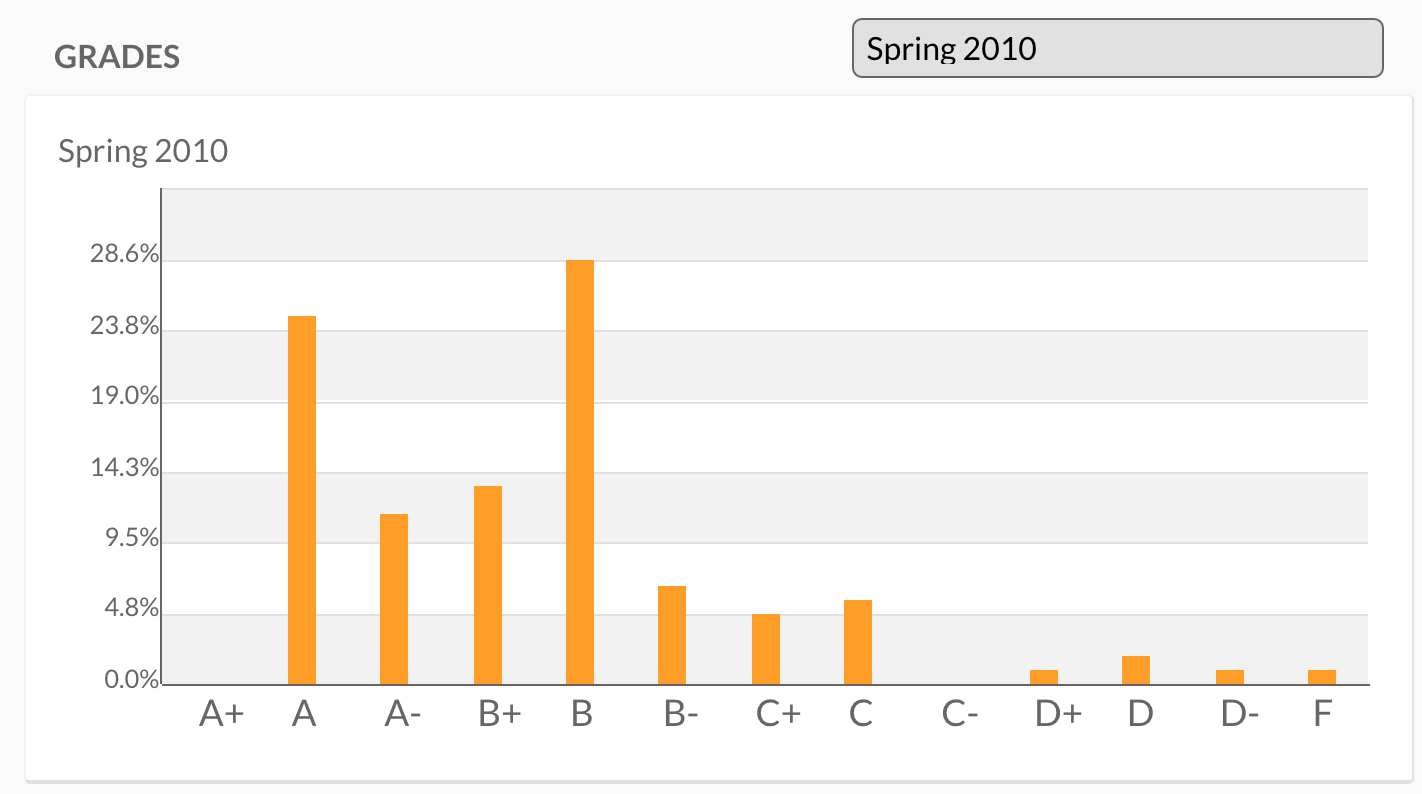
Merely which classes have inconsistent curves and require you to do more research?
Let's look at four GEs that vary significantly, based on the median percentages of students who earned A'due south.
These 2 graphs provide a sense of what grade variation looks similar. Circles that are more than spread autonomously point larger differences in the grade distributions. Each color represents a dissimilar professor, and circles of the same color that are spread apart suggests the professor may use a less predictable grading scheme.
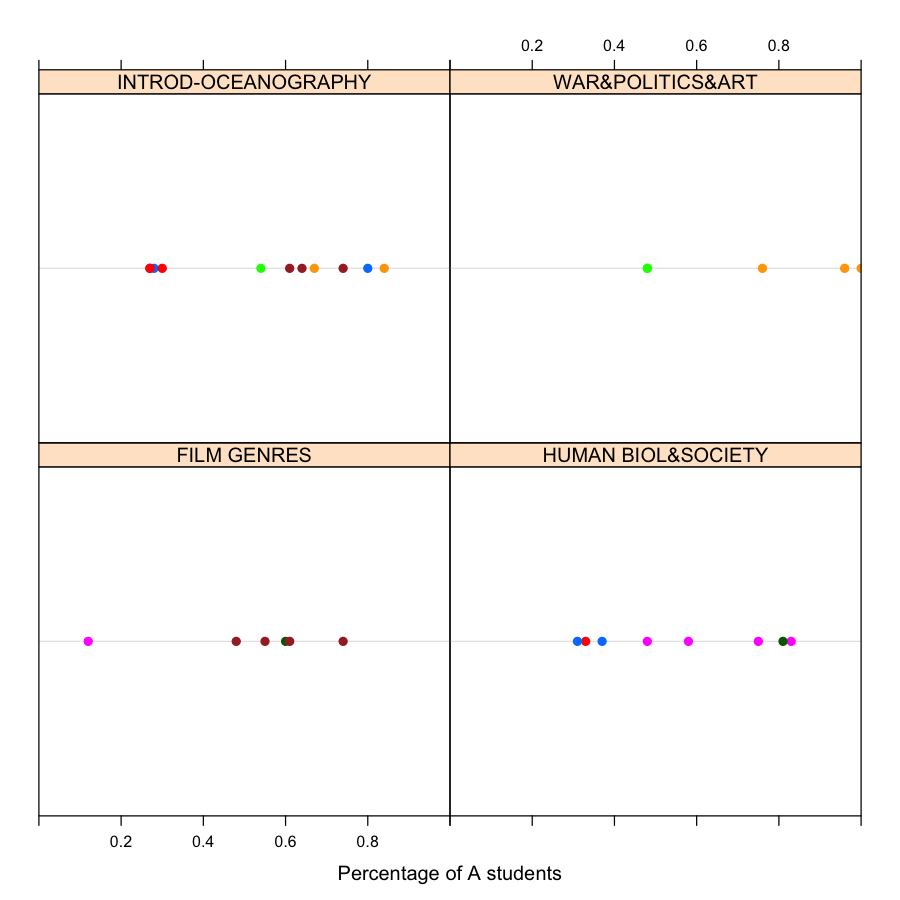
Students who took Earth Planetary Sciences 15: "Intro to Oceanography" had between a 61 and 84 percent run a risk of earning an A. Unlucky students enrolled in lectures for which instructors awarded A's to less than 30 percent of students.
At other end of the spectrum, students who took Life Sciences 15: "Concepts and Issues" across x different lectures over the concluding three years were graded on roughly the aforementioned curves. A 3rd of students earned A's in the toughest lecture, and 37 percent earned A'southward in the easiest lecture – a much smaller variation.
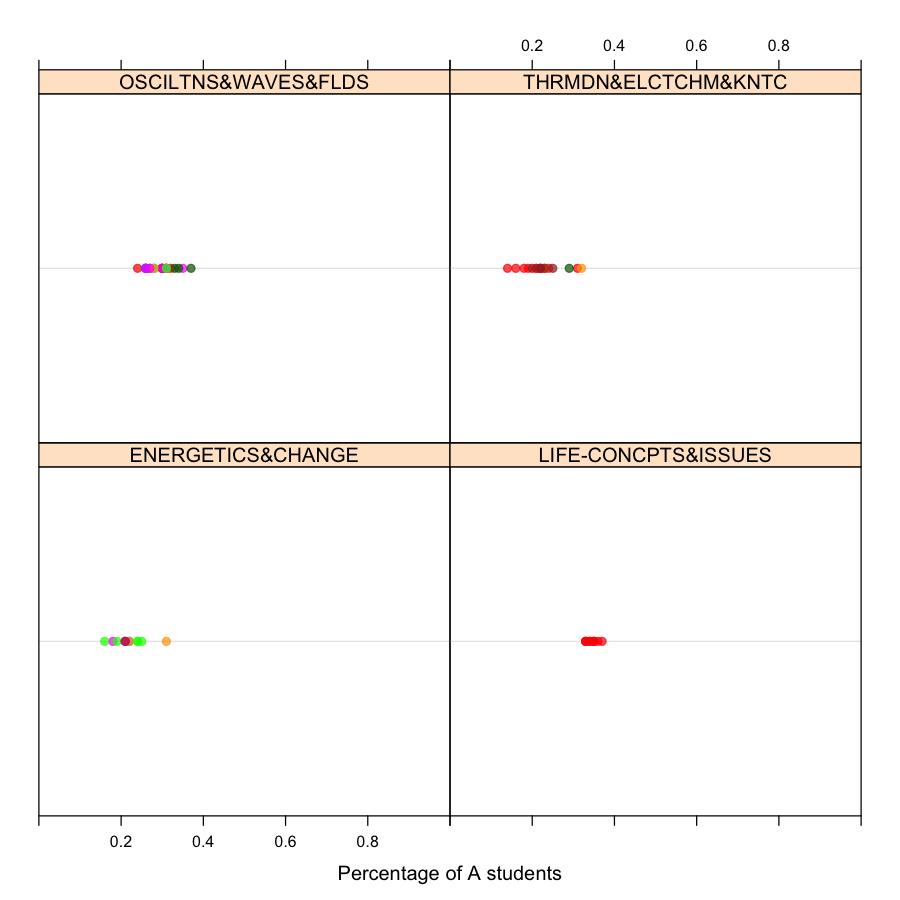
We can conclude some professors may make conscious decisions to grade more consistently, and some core lower-division classes tend to have more consistent grade distributions.
In most cases, our data confirms information technology is of import to choose the right lecture or quarter during which to take a form.
Curious about the bend consistency of a item GE grade yous have in listen?
Use the searchable table below.
The table only includes classes that have been taught at least three times since fall 2012. The default tabular array sorts courses from almost to to the lowest degree standard deviation using the aforementioned metric, the number of A's, as to a higher place.
Look upward whatsoever GE grade
Looking for a specific form? Trying to detect the perfect GE? Use the searchable table beneath.
The tabular array only includes classes at least 50 students take taken since fall 2012.
Stay tuned for upcoming posts
In the coming weeks, we'll continue to clarify class distributions to reply more than questions. Which professors are harder than their department average? Practice smaller classes have more favorable curves than larger ones?
Take burning questions of your ain? Email usa or comment below!
About the information
The data used was obtained through a public records request submitted to the UCLA Registrar. It contains grade distributions for classes with more than than ten students from autumn 2012 to fall 2015.
0 Response to "Arts and Sciences Osu Visual and Performing Art Ge"
Post a Comment